

How To Calculate Engagement Rate: 2026 Formulas & Benchmarks
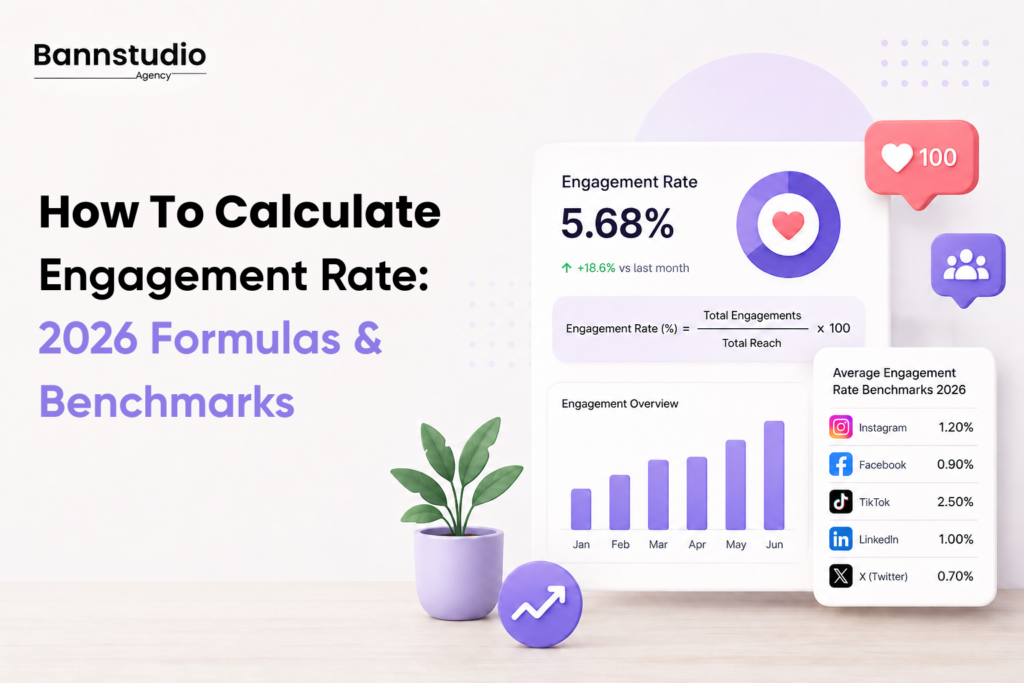
Likes and followers do not reflect everything anymore. Marketers in 2026 are more concentrated on the engagement rate since it defines the interaction level of the audience with your content as opposed to viewing it. With the development of AI algorithms on Instagram, LinkedIn, Facebook and TikTok, engagement signals are becoming more critical in the content’s distribution process. For those who want to work with performance marketing agency in Madhya Pradesh or digital marketing companies in Madhya Pradesh, knowledge of the engagement rate is vital. This will be helpful for the improvement of the performance of your campaigns and return on investment. What is Engagement Rate? The engagement rate indicates the percentage of users interacting with your content through the following activities: Unlike impressions and followers, engagement rate reflects the efficiency of your content with the audience. In 2026, many marketers consider engagement one of the most significant factors of quality content. Why Engagement Rate is Important in 2026 The advent of AI recommendation engines has brought about change in the way content is distributed. Content is being recommended on Instagram, LinkedIn, and TikTok to relevant audiences based on both relevance and engagement indicators, regardless of how many followers one has. It allows for small brands to get substantial reach if their content does well. If you invest in performance marketing services for e-commerce brands, then high engagement will give you: A lot of companies which are operating with a digital marketing agency in Madhya Pradesh are now evaluating the performance of their campaigns through revenue, ROAS and engagement rates. Formula 1: Engagement Rate by Reach (ERR) This formula is considered the most popular in 2026. Formula: ERR = (Total Engagements ÷ Reach) × 100 Example: Total engagements: 500 Reach: 10,000 ERR = (500 ÷ 10,000) × 100 ERR = 5% This type of calculation helps in determining how many people are engaged after they have seen your content. Formula 2: Engagement Rate by Followers (ERF) Although some brands continue calculating ERF due to its simplicity, it makes possible a straightforward comparison between accounts. Formula: ERF = (Total Engagements ÷ Total Followers) × 100 Example: Total engagements: 500 Followers: 20,000 ERF = (500 ÷ 20,000) × 100 ERF = 2.5% This formula can be helpful for measuring the account performance but it may not consider the visibility of each post since not all followers see the posts. Formula 3: Engagement Rate by Impressions This formula is frequently applied to paid advertising campaigns. Formula: Engagement Rate = (Total Engagements ÷ Impressions) × 100 This indicator allows marketers to assess the effectiveness of paid content in terms of generated interactions per total number of views. The majority of performance marketing agencies working with e-commerce brands use this formula while analyzing campaigns on Meta and LinkedIn. What Is Considered a Good Engagement Rate in 2026? There is no universal benchmark applicable for all platforms and industries. As it follows from benchmarking studies conducted recently: Instagram Below 0.43%: Below average 0.43%–1%: Average 1%–3%: Strong Above 3%: Excellent LinkedIn Average engagement rates can be between 2% when it comes to business content, where carousels, PDF, and videos can beat normal posts. TikTok Average engagement rates are higher than 2%, making TikTok one of the highest-engagement social media platforms. Facebook Engagement rates are lower than that of other social media platforms, often lower than 1%, but Facebook continues to generate high click-through rates and conversions. Common Engagement Rate Mistakes Most brands misunderstand their engagement rates data. These are some of the mistakes to avoid: Only Paying Attention To Likes Saves, shares, and comments are more valuable metrics compared to likes. Comparing Different Social Media Platforms If the engagement rate on LinkedIn is 2%, then it does not mean the same on Instagram. Ignoring Reach-Based Metrics By 2026, many experts advise focusing on engagement metrics based on reach due to changes in content discovery by non-followers. Chasing Vanity Metrics A huge follower base doesn’t necessarily translate into business success. That’s why many businesses using digital marketing services in Madhya Pradesh prioritize engagement rates. Tips to Improve Engagement Rate For brands experiencing lower rates of engagement, the following types of content should be considered: The recent research continues to prove that Instagram Reels perform better than many other formats when it comes to both engagement and reach. For those working with performance marketing agencies for e-commerce brands, combining engaging organic content with paid promotion usually works best. Conclusion The engagement rate is definitely one of the most important social media metrics in 2026. Though it is helpful to know the number of followers and how many impressions your content gets, engagement will tell you if your audience is really interested in what you post. Regardless if you collaborate with a performance marketing agency in Madhya Pradesh, a digital marketing agency in Madhya Pradesh or handle everything yourself, proper calculation of engagement can help you get more from your content and marketing efforts in general. FAQs Q1: What is the ideal engagement rate calculation formula? A: It is Engagement Rate by Reach (ERR) because it focuses on users interacting with content who have seen it. Q2: What is the ideal Instagram engagement rate in 2026? A: 1% to 3% is considered good and anything above 3% can be deemed excellent. Q3: Why is engagement rate important? A: Because it aids in measuring effectiveness of the content, interest of the audience and even potential ways of distributing the content. Q4: Should engagement rate be calculated by followers or reach? A: Calculations based on reach are becoming popular because modern social media distributes content to people outside followers. Q5: Can engagement rate affect ad effectiveness? A: Yes, because high engagement rate improves relevance of ads, reduces cost and makes the campaigns effective.