

How the “Cockroach Janta Party” Trend Took Over the Internet And What We Can Learn From It
Over the last few days, one phrase has completely taken over Indian social media: “Cockroach Janta Party”. From Instagram reels and meme pages to political edits and parody posters, the phrase has become one of the most talked-about internet trends right now. What started as a political remark quickly transformed into a full-scale viral moment online. And while the internet is treating it as entertainment, for marketers and creative agencies, this trend is actually a fascinating example of how modern digital virality works. Before anything else, this blog is not political and does not take sides. We are looking at this purely from a branding, internet culture and marketing perspective. How Did the “Cockroach Janta Party” Trend Start? The trend reportedly began after a political statement made during a public discussion was clipped and circulated online. Social media users picked up one particular phrase from the conversation and started turning it into memes, edits and parody content. Within hours, the phrase escaped its original political context and became a meme format of its own. Users began creating: What made the trend spread even faster was how adaptable it became. Internet users belonging to various online communities began to remix the meme into their own versions. This is precisely how internet culture grows in 2026, through participation rather than through any sort of initiative. Why Did The Trend Become Viral Instantly? The “Cockroach Janta Party” trend had all characteristics that make a piece of content go viral. There were: Yet the primary reason why the trend grew was the involvement of an audience. Instead of passively watching the trend, people started to participate in it. Each and every post that included the trend brought the latter even more popularity. Social media platforms such as Instagram and X fueled this engagement process by spreading it through algorithms. From the viewpoint of digital marketing, this is community-driven virality. What can marketing agencies learn from the trend? The internet today rewards content that feels: One random political remark turned into a nationwide meme because people found it entertaining enough to recreate repeatedly. That is a huge lesson for marketers. The biggest campaigns in 2026 are often not the ones with the largest budgets. They are the ones that understand internet behaviour and audience psychology the fastest. The Rise of Meme Marketing and Internet Culture Modern branding is no longer limited to polished advertisements. Today, brands grow through: This does not mean brands should force themselves into every trend. But it does mean marketers need to understand why certain moments capture public attention so strongly. The “Cockroach Janta Party” trend is a perfect example of how the internet transforms one unexpected line into a massive social media conversation. What We Learn at Bannstudio From Trends Like This At Bannstudio Digital Agency, trends like these are genuinely interesting because they reveal how digital audiences think, react and engage online. Great campaigns often come from observing internet behaviour closely. Sometimes the strongest creative ideas start from: As a modern marketing agency, understanding internet culture has become just as important as understanding advertising itself. Because in 2026, attention is earned through relevance and creativity. And sometimes, one unexpected sentence can become the biggest campaign on the internet overnight.
Modi Ji Said “Work From Home”? Here’s How Marketing Agencies Were Prepared For It
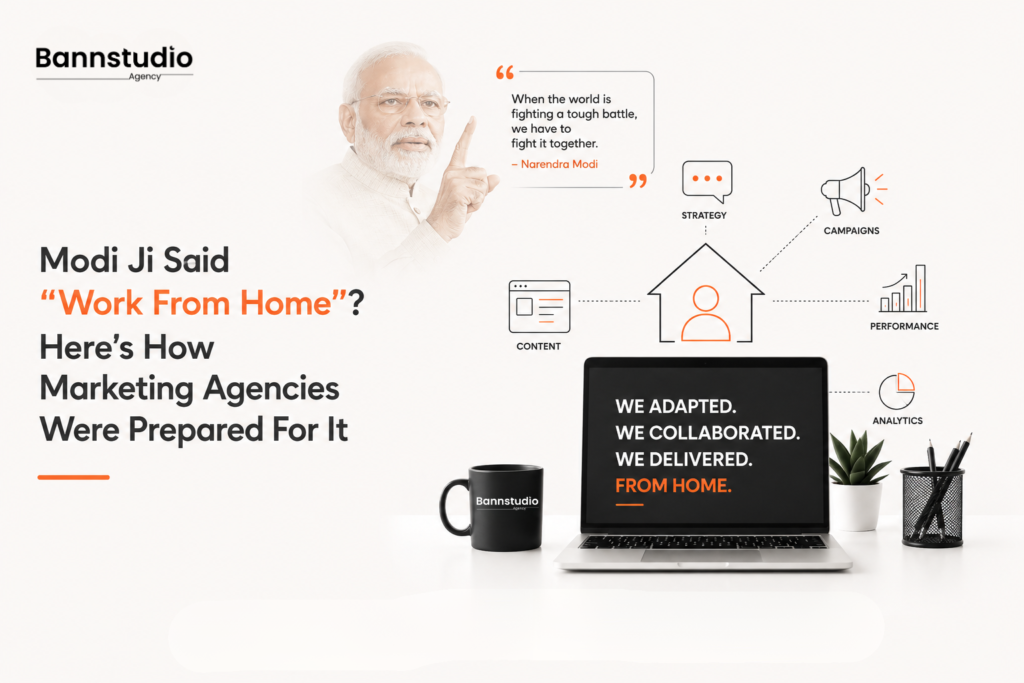
After Prime Minister Narendra Modi mentioned the possibility of considering work from home and video calling whenever possible, the internet has genuinely had a field day with it. Now there are sorts of reels on Instagram where employees are forwarding the speeches of Modi Ji to their employers with comments like: “Sir, national instructions hain.” or “Work from home confirmed?” Meanwhile, LinkedIn members are calling it the comeback of remote work culture, office groups are flooded with memes, and marketing agencies are making jokes about Zoom meetings being officially patriotic now. But while the internet seems to treat it as a brand new trend, creative agencies were thinking: “This is what we’ve been doing all along.” At Bannstudio Digital Agency, hybrid work culture has always been a part of our everyday life, as some of our teams work remotely, others in the office depending on current projects, shoots and creative workflows. “The Office vs Work From Home” Debate Is Over Until recently, flexible work was a fallback plan for companies. However, in 2026, hybrid work has proven itself to be a business advantage. In particular, for: As a rule, most of the work is done remotely anyway. Campaigns are managed in dashboards. Meetings take place on Google Meet. Edits are made on Figma. Approvals are quicker on WhatsApp than by e-mail. The myth about the presence of productivity within office walls seems outdated. Creativity Doesn’t Have a Fixed Location The best ideas in our agency were born: And this is the beauty of hybrid work culture. At Bannstudio, we care more about creativity, communication and results than the fact that someone is sitting at their desk from 9 to 5. Because let’s face it; marketing should be all about ideas, not the presence in the office. Does Remote Working Work for Agencies? Short answer: yes. Long answer: yes, if the culture is healthy. Remote working doesn’t work if the teams fail to communicate with each other. On the contrary, agencies function well only if the systems are created properly.In our hybrid working process, we use: Ironically, most remote-working teams currently communicate faster than teams in traditional offices. And also, no one misses “this meeting could have been an email” atmosphere. Clients Care About Results, Not Your Location So here’s one thing that businesses realise in 2026: Your clients don’t really care if your team works in an office or at home. What they care about is: Whether the video was made in the office or on the couch at 1 am, it won’t affect its quality whatsoever. Moreover, flexible working culture sometimes helps agencies attract even more creative workers who need balance. The Future of Work is Likely to Be Hybrid This whole discussion on remote work is more than just a fad. It is actually a huge change taking place right now across many industries. There is a realization that flexibility leads to: In the case of marketing agencies, it only makes sense to have a hybrid work culture. Some days require the energy of the office environment. Some days require nothing but your headphones, absolute silence, and the comfort of your own home. Both can exist at once. Conclusion Although the internet might call it the “Modi Ji work from home trend”, there is no denying that flexible working has been developing for quite some time. At Bannstudio Digital Agency, we believe that hybrid working is the future of modern marketing agencies where creativity isn’t restricted by location. As successful marketing campaigns depend on good ideas, effective teamwork, and execution.