

Local SEO vs Google Ads vs GEO: Which Strategy Is Best for Your Business?
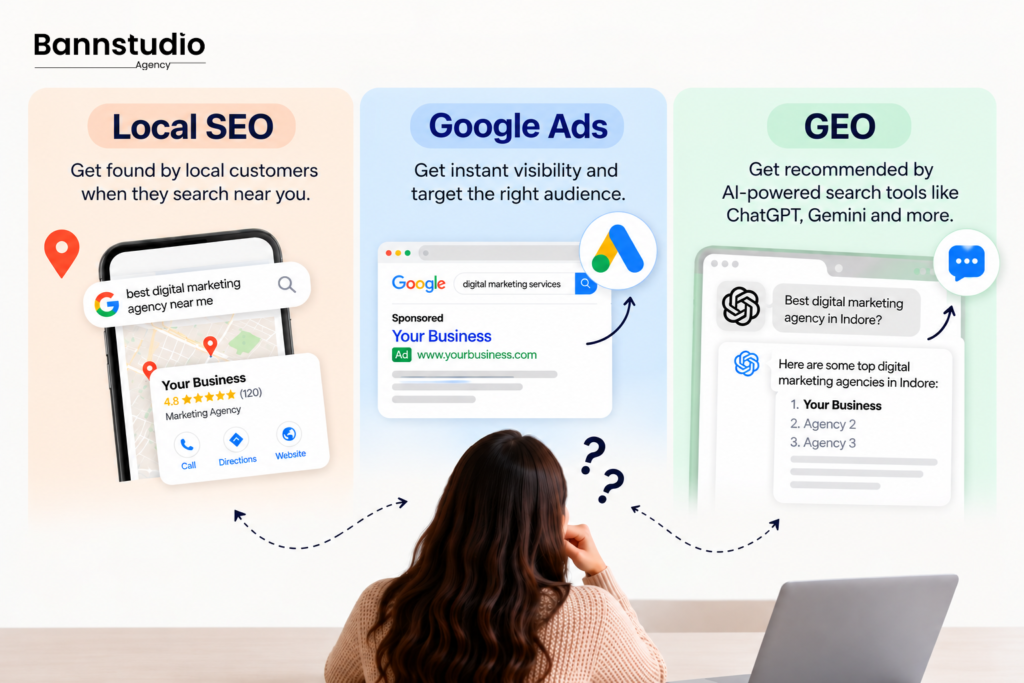
How people discover businesses online is changing faster than ever before. A few years ago, most people searched on Google, clicked the link to the website, and made a decision. Today, however, they can find your business thanks to Google Maps, a paid advertisement or an AI tool like ChatGPT, Gemini or Perplexity. That is why many businesses today wonder where they should invest their marketing budget. Should you do Local SEO, run Google Ads or optimize for GEO (Generative Engine Optimization)? Your choice depends on your goals, timeframe and target audience. What Is Local SEO? Local SEO is an approach designed to help businesses rank in location-based searches. If someone searches for “nearby restaurant”, “dentist in Indore” or “marketing agency in Madhya Pradesh”, Google displays those businesses that are geographically relevant to the person. The steps involved in Local SEO include: The most obvious advantage of Local SEO is its sustainability. Once your business starts ranking, you can get new traffic and inquiries without paying per every click. Best For: What Are Google Ads? Through Google Ads, businesses will get an opportunity to appear at the top of search engine result pages almost immediately. Instead of waiting months for better rankings, you will start getting visibility right from the first day of your campaign. Google Ads are those ads where businesses need to pay each time their ad gets clicked. This is one of the fastest methods of getting traffic, inquiries, and sales. Pros: Quick results Cons: As soon as the budget is exhausted, results stop. Best For: What Is GEO? GEO stands for Generative Engine Optimization, and it’s among the newest innovations in digital marketing. While conventional SEO is all about website optimization in relation to search engines, GEO focuses on getting businesses visible in the responses generated by AI platforms such as ChatGPT, Gemini, Claude, and Perplexity. As more users turn to chatbots for recommendations, businesses require content that is understood, referenced, and trusted by the AI system. Typical components of GEO are: Whereas SEO helps you rank on search engine results pages, GEO makes you part of AI-generated answers. Local SEO vs Google Ads Each strategy can generate customers but in its own way. Local SEO is patient. Building rankings, reviews and authority can take several months. Nevertheless, the results are often long-lasting. Google Ads bring instant visibility and fast lead generation. However, you pay for each click and lose visibility once campaigns are paused. Therefore, if you are after quick results, Google Ads is likely the better option. However, if sustainable growth is what you are after, Local SEO is the better deal. Local SEO vs GEO In fact, these two marketing strategies complement each other. They both need quality content, correct business information, high-quality reviews and authority signals. The only difference is that while Local SEO helps businesses rank on Google Search and Maps, GEO helps businesses become visible in AI-generated recommendations. Since AI search continues to evolve, the combination of the two strategies may help businesses win a competitive advantage. Google Ads vs GEO Google Ads buy visibility. GEO earns visibility. While Ads allow your business to appear before potential customers right away, GEO works on building authority recognized by AI algorithms. If you need your business to get leads quickly, Ads are vital. If your goal is to prepare your business for the future online presence, GEO is crucial. So, Which Strategy Is Best? Neither Local SEO nor Ads or GEO is the only winner. Use Local SEO if your business depends on customers of a particular city/region, and you focus on sustainability. Use Google Ads if you need quick leads, traffic or sales. Use GEO if you need your business to stay visible as AI-powered search engines grow. Most businesses are best served with the combination of all three strategies. Local SEO ensures that customers will find you in your area. Ads ensure quick traffic. And GEO makes sure that you will be able to stay visible even with the rise of AI engines. Conclusion It’s hard to say which channels in digital marketing are more effective today since the answer depends on the particular company and its goals. Businesses that incorporate Local SEO, Google Ads, and GEO usually have a higher chance of getting customers at all stages of their modern search journeys. The question is not which is the best choice. The question is which approach is best for you right now. Frequently Asked Questions Q1: Which is better, Local SEO or Google Ads? A: This is a tough question. Local SEO will bring better results in the long term. Google Ads is the way to go if immediate traffic and leads are the goals. Q2: What does GEO mean in digital marketing? A: The abbreviation stands for Generative Engine Optimization. This approach aims to improve the visibility of a brand through the AI-powered answers provided by platforms like ChatGPT, Gemini, Claude, and Perplexity. Q3: Should small businesses pay attention to Local SEO? A: Yes. In many cases, Local SEO will be one of the most cost-effective methods of marketing for businesses serving customers in a specific geographic location. Q4: Is there a way to combine Local SEO and Google Ads? A: Yes, absolutely. Google Ads is being used by businesses for fast leads generation and local SEO rankings as a base for further development. Q5: Is GEO taking the place of SEO? A: No. GEO is not taking the place of SEO. Rather, it becomes an extra layer of optimization as the AI-powered search is developing. Q6: Which strategy works the fastest? A: Google Ads will work the fastest. Local SEO and GEO take more time but promise better results in the long run.
10 Costly Google Ads Mistakes Startups Make (And How to Fix Them Fast)
You’re running Google Ads, but the results are not matching your expectations. You may get clicks, but not enough calls or sales. There are many reasons why this could happen, but the most common one is that your Google Ads setup is not doing its job. And that’s where we come in. We’re here to guide you to recognise the most common mistakes startups make while running Google Ads, and how you can fix them quickly. But first, let’s understand why this is important for your business. Why this matters in 2026 Google Ads have become more data-driven and competitive. Costs per click has increased in many industries, especially for local services. If your campaigns are not optimised for that, your money gets used up without seeing any results. For startups or small businesses trying to grow locally, working with a Digital Marketing Agency in Gwalior like Bannstudio improving your own setup can directly impact your revenue. And to improve your setup, you will have to understand what mistakes you might be making with them. 1. Targeting the wrong audience Your budget won’t turn into leads if your ads are reaching the wrong people. What usually goes wrong: Instead, do this: 2. Not Paying Attention to Local Searches People often search for things that are close to them, like “near me” or “in Gwalior.” You miss out on high-quality traffic if your ads don’t match this. What usually goes wrong: What to do instead: 3. Bad experience on the landing page Your ad gets people to your page, but it doesn’t turn them into customers. What usually goes wrong is: What to do instead: 4. No proper tracking of conversions You can’t get better at something if you don’t keep track of your results. What usually goes wrong: What to do instead: This is a key focus area for any performance marketing agency in Madhya Pradesh. 5. Bad Keyword Strategy Keywords control who sees your ads. Picking the wrong ones changes everything. What usually goes wrong: What to do instead: 6. Bad Ad Copy People won’t click on your ad if it doesn’t clearly explain what you’re offering. What usually goes wrong: What to do instead: 7. Not Using Ad Extensions Ad extensions make ads more visible and get more people to click on them. What usually goes wrong: What to do instead: 8. Bad Budget Planning If you spend money without a plan, you won’t do well. What usually goes wrong: What to do instead: 9. No regular optimization You need to update Google Ads often. Not changing campaigns hurts performance. What usually goes wrong: What to do instead: 10. No clear plan If you run ads without a plan, they won’t always work. What usually goes wrong is: What to do instead: Final Thoughts Google Ads can generate leads quickly, but only when managed properly. Small mistakes can reduce your return without you noticing. If you want consistent results, you need the right setup, tracking, and regular optimisation. Many businesses choose to work with digital marketing agencies such as Bannstudio to manage this process and improve performance. At Bannstudio, we focus on building campaigns that are structured, data-driven, and focused on real business results. If you need this for your business, feel free to reach out and we’ll help bring actual leads to your business.