

Festive Marketing Services for SMEs: Industry-Specific Strategies to Grow Your Business
The festive season is a chance for companies to attract new clients, make special offers and boost sales. However, posting festive wishes and running a discount campaign may not suffice to set yourself apart. Small and medium-sized enterprises require marketing strategies that are relevant and serve particular business aims. This is where the idea of festive marketing services for SMEs comes in, from creation and distribution of content to running advertising campaigns and generating leads. No matter if you run a retail store, real estate firm, automobile dealership, hotel or education institution, a properly organised festive campaign will allow you to make better use of the festive period. What Are Festive Marketing Services? Festive marketing services help plan and implement marketing campaigns for special occasions such as Diwali, Dussehra, Navratri, Christmas and many others. Festive marketing services can include: The appropriate combination varies from business to business based on the budget and goals. Why Do You Need Festive Season Marketing For Your SME? The festive seasons result in higher levels of interest from consumers regarding various activities like shopping, gifting, travelling and dining etc. But there is also heightened competition among businesses as brands vie for customers’ attention. According to Google’s festive shopping research, about 90% of the Indians shopped for themselves or gifts during the Navratri and Diwali period did prior research. This underscores the need for engaging customers while they are still researching and evaluating their options. With the proper festive marketing services for SMEs, you can: The objective is not only to publish festive content but to give your customers reasons to think of your business. Festive Marketing Strategies for 5 Industries Each type of business serves a particular audience and seeks to achieve different goals. For example, a retailer may seek immediate purchases, whereas a real estate company may pursue leads and site visits. The strategies below will depend on your goals. 1. Retail: Convert Festive Interest into Sales Retail businesses can use festivals as a chance to promote new collections, gifts, and limited-time offers. Festive marketing services which might be useful for retailers are: For instance, you can create an outfit guide for a clothing store or a hamper guide for a gift shop. The main aim is to make it easy for customers to discover products and learn about them. 2. Real Estate: Generate Property Enquiries Festive campaigns may be used to attract potential buyers and make them pay a visit to the property. In case of property promotion, however, there is a need to have more information available and trust established. Among others, the following services may be helpful: Example: For instance, a residential developer can launch a Diwali campaign to show off the available apartments, the amenities of the project and the possibility to visit the project site. The goal is to obtain relevant enquiries. 3. Automobile: Launch Test Drives and Bookings Automobile dealerships can leverage the power of festive campaigns in order to highlight the new models, provide details about the available offers and invite potential customers to visit the dealership. Useful festive marketing services include: Example: An auto dealership could produce some short videos on the interiors, safety features and design of the car, then provide a clear invitation to arrange a test drive. Offer details should be accurate and transparent, especially in case of financing and time-limited offers. 4. Hospitality: More Reservations and Events Booked Hotels, restaurants, cafés and resorts could leverage festive marketing to promote various dining experiences, special offers, stays, events and venues for private parties. Festive marketing services useful for this would include: Example: A hotel could promote a festive dining experience via food photography, short videos of its ambience and advertising encouraging customers to make a reservation. Clear visuals help customers understand what experience they might expect, while booking details help to inquire. 5. Education: Build Trust and Generate Enquiries For schools, colleges and coaching institutes, festive marketing can enhance community outreach and portray the university life in addition to aiding admissions, especially in case enrollment periods coincide. Marketing services which can be useful for festive marketing include: For example, a school can launch festive video with depiction of involvement of students in cultural activities in addition to the celebration, while a campaign targeting admission can give details about the program and campus visit. Marketing campaigns should be based upon the strengths of an educational institution, rather than being solely dependent on festive greetings. How to Launch a Successful Festive Marketing Campaign A successful marketing campaign cannot depend only upon great creatives. The businesses need to consider the whole customer journey from discovering to making enquiries or purchases. Following points can guide a successful marketing campaign: Starting early will give you time to test your messaging and make any necessary changes before the most busy days come. Why Opt for Professional Festive Marketing Services for SMEs? Running your festive promotions along with routine business may prove to be difficult, especially for small businesses. Professional marketing help can assist you in combining your strategy, creatives and campaigns. A proper marketing service can help your business: When evaluating an agency, review its relevant portfolio, understand the proposed deliverables and ask how campaign performance will be measured. Choose a service plan that fits your budget and business priorities. Conclusion The holiday season presents SMEs with possibilities of expanding their client base and enhancing customer relationship building. However, the most valuable campaigns are those whose design is based on specific business needs instead of random festive posts. Festive marketing services for SMEs can help to combine campaign strategy, creative content, social media activities and paid promotion in line with these business needs. Whether your company works in retail, real estate, automobiles, hospitality or education, the right way to go about the festive marketing will depend on your customer needs and intended actions. With advance preparation, relevant content, and careful performance measurement, your business can achieve more targeted and efficient festive marketing. FAQs 1. What does festive marketing services
From Raw Footage to a Powerful Brand Film: The Making of ACME’s Corporate Video by Bannstudio
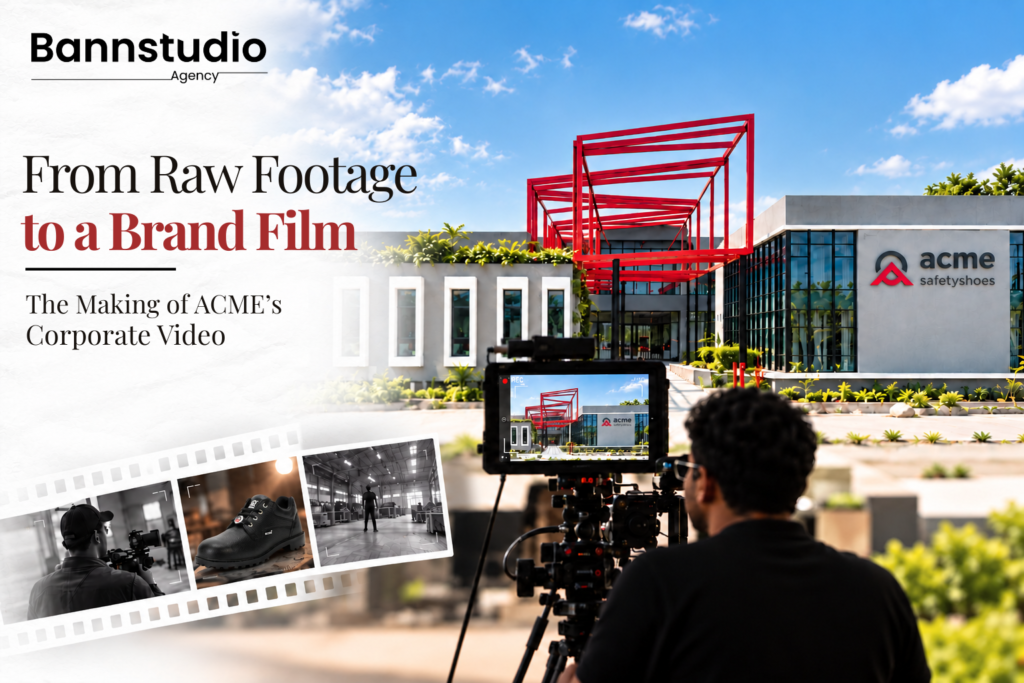
Apart from its products, the manufacturing company has many other features that can be shared with the audiences. There are long years of experience and technical processes performed by various specialists in order to make the company exist and operate successfully. Corporate film combines these characteristics allowing the viewers to get acquainted with the company and its capabilities apart from the information provided about its products and name. Video production house HawkbyBann worked on a corporate film for ACME Universal Safezone 9 Limited, a known producer of industrial safety shoe manufacturer. Interested in the final product? Watch the ACME corporate video on YouTube: Introduction to ACME Universal Being founded back in 1994 in Gwalior, Madhya Pradesh, ACME Universal is known for the production of industrial safety shoes. The company’s growth proves its rich experience in this industry. According to the information available on the company’s official website, ACME has a manufacturing capability of more than 13,000 pairs of shoes daily. Some facts about the company: As a company of this size, the representation of capabilities goes beyond merely displaying their products. The company’s manufacturing capabilities, product range and workplace safety culture all form part of their identity. Making a Story Out of a Manufacturing Business The starting point in corporate video production is the answer to one very important question: what does the audience need to learn about the business? Manufacturing firms may often have complex operations with plenty of technical information to share. Therefore, the filming has to structure all of that in a story that is both educational and digestible for the viewer. In case of the safety footwear manufacturer ACME, one can approach the task by focusing on three essential areas: All of this together enables corporate film to not only introduce the business but also to provide viewers with a deeper insight into the company’s activities. What Does it Take to Create a Corporate Film? A corporate film goes through a number of steps, each one contributing to the final product. 1. Getting to grips with the brief In order to get ready for filming, the production team needs to have an understanding of the company’s goals and target audience. This is achieved by establishing: 2. Establishing the visual narrative Having defined the communication strategy, the next step is to define how it will be translated visually. When creating a manufacturing film, it may involve planning the shots according to the following items: 3. Preparation for the Shoot Film production at a working manufacturing facility requires proper coordination. The following must be considered by the production team: Such preparations will allow the team to film efficiently and get the footage that will be useful for the film. 4. Post-production Post-production will allow making the footage cohesive and turning it into a corporate film. Post-production includes such steps as: The result is a consistent film that shows the professional image of the company. The Role of HawkbyBann in the ACME Project Video production is one of the creative directions at Bannstudio. With the help of HawkbyBann we develop projects that allow businesses to communicate through video. ACME corporate film is one of the examples of such projects developed in cooperation with the company that produces industrial safety footwear. This type of video project must ensure that the production process represents the company’s identity, products, and communication. The final film may also be a reusable company asset that will serve as a medium for communication in the following areas: So, the corporate film is another great way for the company to introduce itself and its activities. Do You Need to Make a Corporate Film for Your Brand? The corporate video not only introduces the company but also ensures that viewers get to know about its activities, products, and capabilities. HawkbyBann produces video content for businesses interested in corporate communication through film. Here are some of our video production services which might interest you: No matter if you need to introduce your company, present your product range or demonstrate your manufacturing capabilities, we can help you plan your next video project. Looking to create a corporate film for your business? Get in touch with HawkbyBann to discuss your requirements. Contact Us
Navratri Special: Celebrating Creativity Through Festive Designs
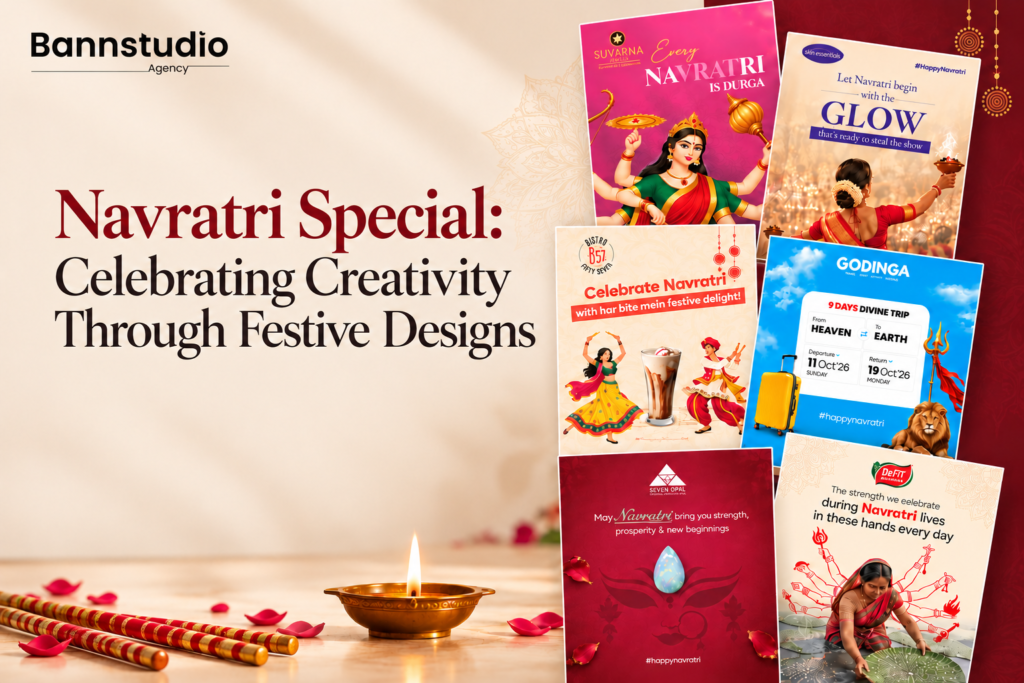
Navratri is a celebration of devotion, positivity, colours, and new beginnings. It is also a wonderful opportunity for brands to connect with their audiences through meaningful and visually engaging creatives. From vibrant festive themes to modern, minimal designs, the right visual storytelling can capture the spirit of Navratri while keeping a brand’s identity at the forefront. At Bannstudio, we believe every festival brings an opportunity to turn creativity into meaningful brand experiences. This Navratri, our team explored unique design concepts that blend festive traditions with fresh, contemporary visuals. Each creative reflects our approach to thoughtful design, attention to detail, and bringing a brand’s message to life. Here’s a look at some of our best Navratri creatives, showcasing how we bring festive ideas to life through design, imagination, and creativity. Suvarna Jewels Skin Essentials Bistro Godinga SevenOpal Defit Nikunj Palladio City
Navratri Marketing Campaign Ideas : 15 Creative Strategies for Indian Brands
Navratri is one of India’s biggest festive opportunities for brands to connect with audiences through culture, creativity and celebration. From fashion and jewellery to food and ecommerce, brands can use the nine days of Navratri to create campaigns around Garba, Dandiya, festive shopping and regional traditions. Here are 15 creative Navratri marketing campaigns by Indian brands to inspire your next festive marketing strategy. Yippee Croma Retail Birla Opus Ashok Leyland Asus India McDonald’s India Pulse Yokohama Crompton Oven Story Mad Over Donuts Paytm Money Wendys India Poona Walla Fincorp Aakash Education Conclusion The best Navratri campaigns connect with audiences through relatable storytelling, interactive content and ideas rooted in the spirit of the festival. Whether you’re planning a social media campaign, a creator collaboration or a festive product launch, these examples offer inspiration for making your brand part of the celebration. The key is to create something that feels relevant to both your audience and your brand.
Diwali Marketing Budget Guide for SMEs
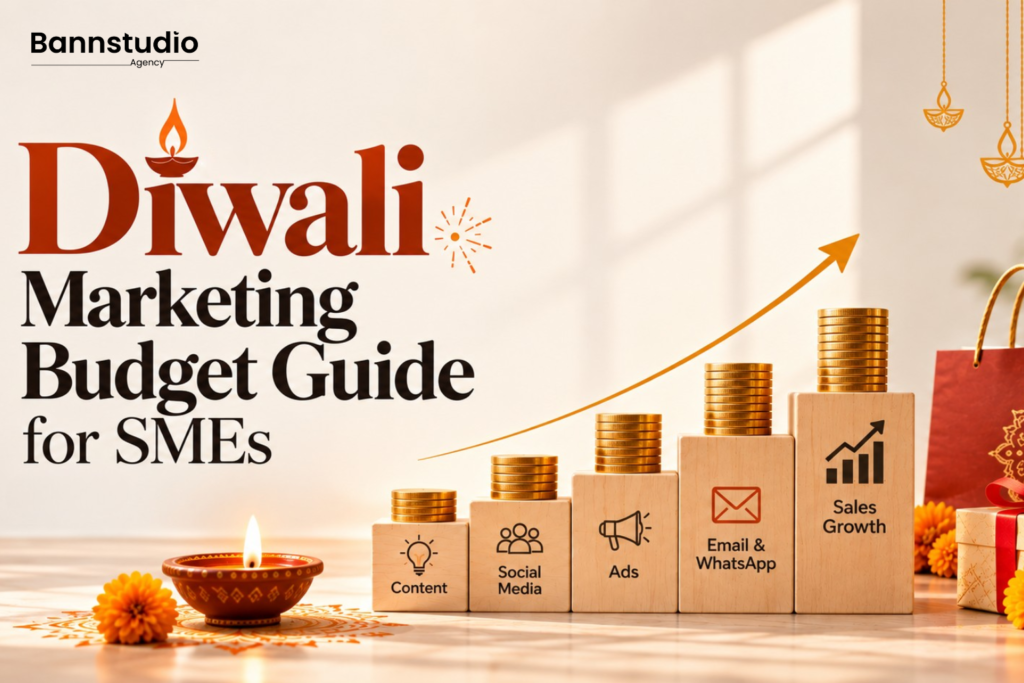
If you have a small or medium-sized enterprise, Diwali will likely become your busiest period of the year, when you are making weeks or even months of revenue in just several days. It could be a shopping mall, restaurant, jewellery company, clinic, beauty salon, or any other business. But every year there is a similar question: How big is your Diwali marketing budget? Unfortunately, there is no definite answer to this question. The successful Diwali marketing budget depends on your goals, field of activity, location, and competitors. Some firms can get good results from just ₹25,000, others may require ₹5 lakhs or more to reach their goals during Diwali holidays. Here, we have created a list of Diwali marketing budget ranges for SMEs in 2026, which will help you allocate the funds properly. Diwali Marketing Budget Planning First of all, you should ask yourself: What is your goal: The budget plan for Diwali marketing should include not only promotions but also the creation of creative materials. Without good creatives, advertising is doomed to fail. So as a rule of thumb: ₹25,000 Diwali Marketing Budget Best For Activity Budget Content creation ₹8,000 Meta Ads ₹10,000 WhatsApp marketing ₹2,000 Google Business Profile optimisation ₹2,000 Contingency ₹3,000 Recommended Approach If your Diwali Marketing Budget is ₹25,000, you need to concentrate on the visibility in a particular region, not everywhere. Things to give priority to would be: Do not dilute your Diwali Marketing Budget into multiple things at this point. ₹50,000 Diwali Marketing Budget Best For Activity Budget Creative production ₹12,000 Meta Ads ₹20,000 WhatsApp campaigns ₹3,000 Micro influencers ₹7,000 Local SEO ₹5,000 Contingency ₹3,000 Recommended Strategy With the budget of ₹50,000 for marketing in Diwali, it is possible to move beyond conventional promotions. Some things you could do with this budget include: Many SMEs find that such a Diwali marketing budget strikes the right balance between reach and cost-effectiveness. ₹1 Lakh Diwali Marketing Budget Best For Activity Budget Content & video production ₹20,000 Meta Ads ₹40,000 Google Ads ₹15,000 Influencer marketing ₹10,000 WhatsApp automation ₹5,000 Landing page & SEO ₹5,000 Contingency ₹5,000 Recommended Strategy A Diwali marketing budget of ₹1 Lakh helps create an effective festive campaign. A budget of ₹1 Lakh would help achieve: If you are looking to aggressively generate leads, this would be an ideal Diwali marketing budget for you. ₹5 Lakh Diwali Marketing Budget Best For Activity Budget Video production ₹75,000 Meta Ads ₹1,75,000 Google Ads ₹75,000 Influencer & UGC campaigns ₹75,000 WhatsApp & CRM ₹25,000 SEO & landing pages ₹25,000 PR & community engagement ₹25,000 Contingency ₹25,000 Recommended Strategy Diwali Marketing Budget of ₹5 Lakh needs to cover a full customer funnel campaign. It can include: At this stage of budget allocation, your Diwali marketing budget should be considered as an investment. Common Diwali Marketing Budget Mistakes However, even companies with huge marketing budgets can have problems if they invest wrongly. 1. Starting Too Late Many companies begin their marketing process just a few days before Diwali. The best outcomes are normally achieved when you start marketing weeks before Diwali. 2. Spend All Your Budget on Marketing All your Diwali marketing budget should not go to advertisements. If you lack quality creatives, videos, and landing pages, then the ads will underperform. 3. Ignore WhatsApp Marketing Consumers want personal connection these days. WhatsApp may turn into one of the highest converting channels for your Diwali marketing budget. 4. No Retargeting Few consumers buy on their first visit. Retargeting should definitely be included in your Diwali marketing budget plans. Suggested Diwali Marketing Budget Split for 2026 For most SMEs, the following allocation works well: Channel Allocation Paid Advertising 40-50% Content & Video Production 20-25% Influencer Marketing 10-15% WhatsApp Marketing 5-10% SEO & Landing Pages 5-10% Testing & Contingency 5-10% This approach ensures your Diwali marketing budget supports awareness, engagement and conversions rather than focusing on only one stage of the customer journey. Final Thoughts Not all businesses will have the same Diwali marketing budget, but what counts is the effectiveness of the budget allocation. With the effective planning of a ₹25,000 campaign, a ₹1 lakh poorly planned campaign can be easily outperformed. It depends on the selection of marketing channels, the preparation of festive content and consistency of customers’ experience through all the stages of engagement. Irrespective of the size of the Diwali marketing budget (₹25,000, ₹50,000, ₹1 lakh or ₹5 lakh), those companies that start planning their campaigns earlier and allocate their resources wisely are the ones which will win the battle during the festive period. Want to Plan Your Diwali Campaign? Bannstudio digital agency is ready to assist businesses in developing festive campaigns that would meet their objectives and be within the budget. We provide content creation services, video production, Meta Ads, WhatsApp marketing, landing pages, SEO and other related services. Contact us today to use our help in allocating your Diwali marketing budget more effectively. Plan your 2026 Diwali Campaign now. Connect with Us
Best AI Tools for Digital Marketing Agencies in 2026
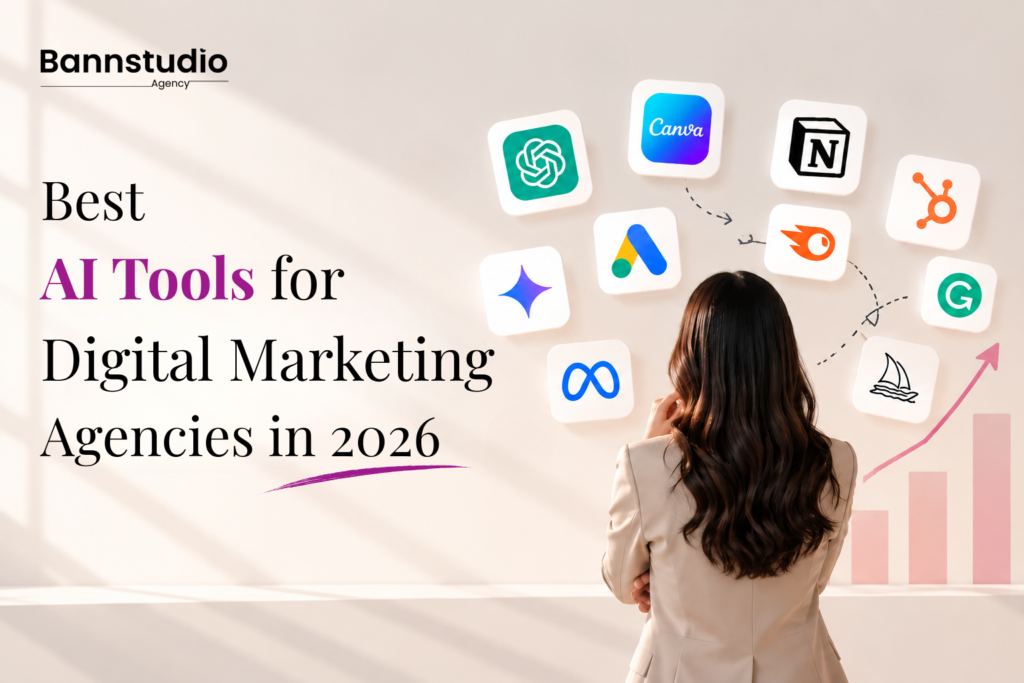
AI is not an additional benefit now; it is a must-have. AI is altering the functioning of the agencies, starting from the content production and planning stage and ending with reporting and automation. Tasks that could take hours now can be done in minutes so that teams can concentrate on more important issues, such as strategic thinking, creativity and clients’ growth. For any social media marketing agency in India in 2026, the question isn’t whether to use AI or not. The question is which tools to choose. Here are some of the best AI tools that help agencies to operate more effectively in 2026. Why AI Matters for Marketing Agencies Modern marketing consists of numerous components. Teams deal with content calendars, ad campaigns, SEO, analytics, communication with clients, reports and creative production at the same time. With AI, teams can: This makes it possible to do even more without increased workload. 1. ChatGPT ChatGPT is one of the most widely used AI tools in marketing. Agencies utilize it for campaigns’ brainstorming, writing content outlines, ad copies and concepts. Best For: ChatGPT has become an everyday productivity tool for many teams. 2. Claude Claude has gained popularity among content strategists and marketing teams. Unlike many AI-based solutions, it processes a lot of information making it suitable for long content, audits and research. Best For: Claude is often used together with ChatGPT rather than as an alternative. 3. Perplexity Research takes a lot of time in marketing. Perplexity helps to get information quickly and provides sources and references for that. Best For: It has become an irreplaceable tool for agencies developing data-driven marketing strategies. 4. Surfer SEO Content creation and content optimization are two different things. Surfer SEO helps agencies increase search visibility analyzing top-ranking pages and optimizing content. Best For: Many agencies combine Surfer SEO with AI content creation process. 5. Ahrefs Being a well-known SEO platform, Ahrefs has developed a set of AI-based capabilities to help with research and content planning. Best For: It’s an integral part of an SEO service provided by agencies. 6. Canva Magic Studio Nowadays, design agencies are actively incorporating AI capabilities into their work. With Canva, you’ll be able to develop social media creatives, presentations and visual content quickly. Best For: This design tool will become invaluable for any social media marketing agency in India. 7. Midjourney Midjourney remains one of the most advanced tools for AI image generation. Though many agencies don’t use it for the final design of their campaigns, it can still be useful for concept development and creative ideation. Best For: 8. Runway The video content is now dominating in digital marketing and Runway is enabling agencies to develop videos quickly. Its AI capabilities significantly reduce video creation time. Most Suitable for: 9. Zapier Automating workflow is another huge opportunity for agencies in 2026. Automation can be facilitated by Zapier by integrating apps that would require manual work otherwise. Most suitable for: Even small improvements in automation can help agencies save a couple of hundred hours per year. 10. Looker Studio Despite not being an AI-powered tool, Looker Studio is crucial for reporting and analysis. Agencies use this tool to turn their complex marketing data into dashboards. Best For: How Agencies Are Using AI in 2026 The most advanced agencies do not rely on one particular AI tool only. Instead, they use workflows that may look as follows: Using such workflow combinations, agencies can be both efficient and productive. What This Means for Clients Today, more and more companies require faster and higher-quality services from agencies. For instance, it is true for large social media marketing agency in India or growing social media marketing agency in Gwalior. At the same time, AI does not substitute the strategy, creativity or human experience. The most advanced and productive results can be achieved by people who understand how to combine all these things together. This is why companies like Bannstudio digital agency keep investing in technologies that make the workflow more efficient without sacrificing the creative approach that should be a cornerstone of each campaign. Final Thoughts Artificial intelligence is changing the face of the marketing industry; however, it is the way how to apply tools that really matters. From research and SEO to design, video content creation, and automation, the tools discussed above help agencies to operate faster, make better decisions, and produce great results for their clients. If you are trying to choose a good digital marketing agency in India or Gwalior, it is important to understand which AI-based tools they use. Frequently Asked Questions Q1: What is the best AI tool for content creation? A: ChatGPT and Claude are some of the best AI tools available to users for content creation and blog writing. Q2: What is the best AI tool for SEO? A: Some of the most widely used tools by businesses for doing keyword research and SEO are Surfer SEO and Ahrefs. Q3: Is AI being used by marketing agencies for social media management? A: Yes, many marketing agencies are using AI-based tools for social media management. Q4: Is Canva an AI tool? A: The platform is equipped with some AI-based features on its Magic Studio platform that make it a great tool for content creation and designing. Q5: Can AI substitute digital marketers? A: Not really. Although the AI tool can be used to automate tasks and increase productivity, strategy creation, creative processes, client interaction, and decisions need human skills. Q6: How does the Bannstudio digital agency use AI? A: Bannstudio digital agency, like any modern agency, can take advantage of AI-based tools for research, content production, design, automation, and optimization processes combined with human creativity and strategic thinking.
Local SEO vs Google Ads vs GEO: Which Strategy Is Best for Your Business?
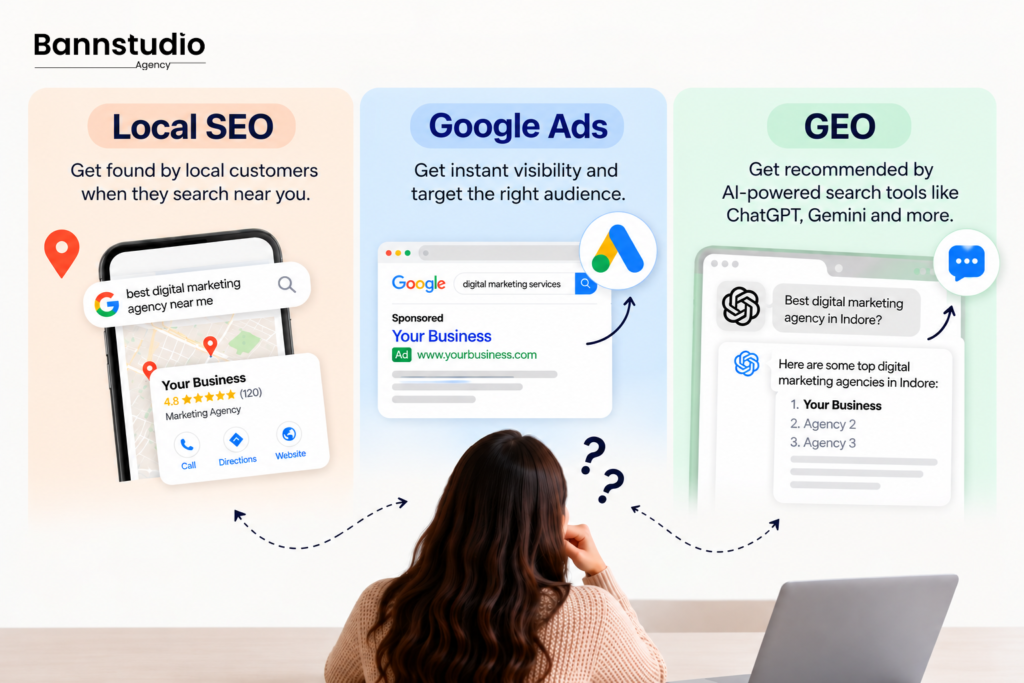
How people discover businesses online is changing faster than ever before. A few years ago, most people searched on Google, clicked the link to the website, and made a decision. Today, however, they can find your business thanks to Google Maps, a paid advertisement or an AI tool like ChatGPT, Gemini or Perplexity. That is why many businesses today wonder where they should invest their marketing budget. Should you do Local SEO, run Google Ads or optimize for GEO (Generative Engine Optimization)? Your choice depends on your goals, timeframe and target audience. What Is Local SEO? Local SEO is an approach designed to help businesses rank in location-based searches. If someone searches for “nearby restaurant”, “dentist in Indore” or “marketing agency in Madhya Pradesh”, Google displays those businesses that are geographically relevant to the person. The steps involved in Local SEO include: The most obvious advantage of Local SEO is its sustainability. Once your business starts ranking, you can get new traffic and inquiries without paying per every click. Best For: What Are Google Ads? Through Google Ads, businesses will get an opportunity to appear at the top of search engine result pages almost immediately. Instead of waiting months for better rankings, you will start getting visibility right from the first day of your campaign. Google Ads are those ads where businesses need to pay each time their ad gets clicked. This is one of the fastest methods of getting traffic, inquiries, and sales. Pros: Quick results Cons: As soon as the budget is exhausted, results stop. Best For: What Is GEO? GEO stands for Generative Engine Optimization, and it’s among the newest innovations in digital marketing. While conventional SEO is all about website optimization in relation to search engines, GEO focuses on getting businesses visible in the responses generated by AI platforms such as ChatGPT, Gemini, Claude, and Perplexity. As more users turn to chatbots for recommendations, businesses require content that is understood, referenced, and trusted by the AI system. Typical components of GEO are: Whereas SEO helps you rank on search engine results pages, GEO makes you part of AI-generated answers. Local SEO vs Google Ads Each strategy can generate customers but in its own way. Local SEO is patient. Building rankings, reviews and authority can take several months. Nevertheless, the results are often long-lasting. Google Ads bring instant visibility and fast lead generation. However, you pay for each click and lose visibility once campaigns are paused. Therefore, if you are after quick results, Google Ads is likely the better option. However, if sustainable growth is what you are after, Local SEO is the better deal. Local SEO vs GEO In fact, these two marketing strategies complement each other. They both need quality content, correct business information, high-quality reviews and authority signals. The only difference is that while Local SEO helps businesses rank on Google Search and Maps, GEO helps businesses become visible in AI-generated recommendations. Since AI search continues to evolve, the combination of the two strategies may help businesses win a competitive advantage. Google Ads vs GEO Google Ads buy visibility. GEO earns visibility. While Ads allow your business to appear before potential customers right away, GEO works on building authority recognized by AI algorithms. If you need your business to get leads quickly, Ads are vital. If your goal is to prepare your business for the future online presence, GEO is crucial. So, Which Strategy Is Best? Neither Local SEO nor Ads or GEO is the only winner. Use Local SEO if your business depends on customers of a particular city/region, and you focus on sustainability. Use Google Ads if you need quick leads, traffic or sales. Use GEO if you need your business to stay visible as AI-powered search engines grow. Most businesses are best served with the combination of all three strategies. Local SEO ensures that customers will find you in your area. Ads ensure quick traffic. And GEO makes sure that you will be able to stay visible even with the rise of AI engines. Conclusion It’s hard to say which channels in digital marketing are more effective today since the answer depends on the particular company and its goals. Businesses that incorporate Local SEO, Google Ads, and GEO usually have a higher chance of getting customers at all stages of their modern search journeys. The question is not which is the best choice. The question is which approach is best for you right now. Frequently Asked Questions Q1: Which is better, Local SEO or Google Ads? A: This is a tough question. Local SEO will bring better results in the long term. Google Ads is the way to go if immediate traffic and leads are the goals. Q2: What does GEO mean in digital marketing? A: The abbreviation stands for Generative Engine Optimization. This approach aims to improve the visibility of a brand through the AI-powered answers provided by platforms like ChatGPT, Gemini, Claude, and Perplexity. Q3: Should small businesses pay attention to Local SEO? A: Yes. In many cases, Local SEO will be one of the most cost-effective methods of marketing for businesses serving customers in a specific geographic location. Q4: Is there a way to combine Local SEO and Google Ads? A: Yes, absolutely. Google Ads is being used by businesses for fast leads generation and local SEO rankings as a base for further development. Q5: Is GEO taking the place of SEO? A: No. GEO is not taking the place of SEO. Rather, it becomes an extra layer of optimization as the AI-powered search is developing. Q6: Which strategy works the fastest? A: Google Ads will work the fastest. Local SEO and GEO take more time but promise better results in the long run.
Best Digital Marketing Agency in India
Selecting the appropriate partner is essential to take your brand to the next level. In today’s market conditions, businesses need much more than just occasional social media posts and advertisement campaigns. They require a solution, which will allow them to increase visibility, generate leads, improve brand recognition and get real business outcomes. This is why companies look for a way to collaborate not only with traditional service providers but also with agencies, which will provide them with end-to-end growth solutions. Speaking about the agencies, which make an impact on the modern market, Bannstudio Digital Agency is the name, which is recognized and appreciated by numerous businesses throughout India. What Does It Take to Become the Best Digital Marketing Agency? In addition to task completion, the best agencies should understand business goals, identify the areas of business growth and develop marketing systems to promote success. A leading agency should be able to unite its creativity, technical skills and performance marketing while adjusting to changes in the market conditions. At the same time, the wide range of interconnected services, which allow agencies to support business growth, is also the key element of the most successful ones. This is how Bannstudio Digital Agency becomes different. Full-Service Marketing Partner Bannstudio offers not just one service, but a variety of marketing and branding services in general. These include: It gives companies an opportunity to take care of several aspects of marketing with one single strategic partner. Making Different Brands Grow Another reason why Bannstudio becomes one of the growing marketing agencies in Madhya Pradesh is that it works in a number of industries. The agency works with companies in hospitality, FMCG, manufacturing, health care, automotive, real estate and consumer industries. This gives the team an opportunity to learn different customer journey paths, market dynamics and business problems. Instead of using some universal approaches, Bannstudio creates strategies depending on every brand’s needs and audience. Where Creativity and Performance Meet There are agencies that focus too much on creativity. And there are those who focus only on performance. Bannstudio does both. Bannstudio is of the opinion that strong branding and growth must go hand in hand. Innovative campaigns are supported by solid strategies, and performance initiatives enhance the value of brands. It is a perfect combination for businesses to build their presence, but also get significant results in form of inquiries, better engagement and high quality leads. A Great Base of Results Bannstudio has established an outstanding reputation over the years thanks to effective execution and customer-oriented solutions. The agency’s growth is based on: All of these achievements show that the agency is focused on making sure that its clients’ brands grow sustainably, and not just become visible for a short time. Digital Excellence from Gwalior Being a reputable digital marketing agency in Gwalior, Bannstudio has successfully expanded its business beyond the regional markets. The agency serves various brands in India, offering them individual approach and strategic collaboration which is usually not typical for other agencies. These two qualities give Bannstudio the capability to work with companies of varying growth stages including startups and emerging companies and also established organizations. Beyond The Marketing Scope It is the vision of the agency that makes all the difference. Unlike other agencies, Bannstudio focuses on making a growth ecosystem. Brand creation, content creation, website creation, performance campaigns and videos – each of these services works towards fulfilling certain business goals. This helps the client in formulating a cohesive strategy instead of fragmented marketing activities. Why Businesses Choose Bannstudio The reason why businesses hire Bannstudio is not because of a task-driven service. What they really want is a team of people who would understand their goals, provide creative inputs, solve problems and help them grow. Be it storytelling or brand creation, lead generation or digital transformation, Bannstudio has been helping businesses face tough times. Conclusion While trying to find the best digital marketing agency in India, one looks for an agency that can provide everything from strategy to creativity to deliverables. With all the services that it provides, varied industry experience and focus on growth, Bannstudio Digital Agency has become the perfect partner for businesses looking to grow. If you are looking for a dependable marketing agency in Madhya Pradesh, or a professional digital marketing agency in Gwalior, Bannstudio has got what you need.
Top 10 Marketing Agencies in Madhya Pradesh

With the increasing trend of digital growth among enterprises in Madhya Pradesh, there has never been more need for good marketing agencies that can help companies succeed in brand building, lead generation, improving online visibility and creating successful campaigns. In Gwalior, Indore, Bhopal and other cities of the state, there are several agencies that assist businesses in growing through combining creativity, strategy and technology. These are the 10 best marketing agencies in Madhya Pradesh to consider in 2026. 1. Bannstudio Digital Agency Number one in our list is the full-service marketing agency that is Bannstudio Digital Marketing Agency from Gwalior. What makes this company special is the fact that it combines all the necessary components for creating a successful business growth system – from branding to content marketing and performance marketing as well as from SEO to web solutions. Among the main services offered by the agency, there are branding, social media marketing, SEO, website development, performance marketing, content creation, packaging design and video production. Among the sectors in which Bannstudio has worked, there are hospitality, manufacturing, healthcare, FMCG and consumer sectors. For firms in need of a reputable digital marketing agency in Gwalior, Bannstudio has made its presence felt. 2. EvenDigit EvenDigit is another popular digital marketing agency based in Indore which is an expert in performance marketing, paid advertising, and search engine optimisation. 3. Chapter247 The firm Chapter247 offers a combination of technologies and marketing services which can be leveraged by businesses to build their digital footprints. From web solutions to digital marketing services, the company has served clients not only domestically but also internationally. 4. TechJogi TechJogi is yet another digital marketing agency which is focused on assisting small and medium-sized firms in their online growth. Its services include SEO, social media marketing, website development and digital strategies. 5. CrazyonWeb CrazyonWeb is a renowned firm based in Indore that offers its clients digital marketing, SEO and website development services. The agency serves those firms which require assistance in improving their search rankings, traffic, and lead generation. 6. Techshu Techshu has established its position as one of the digital marketing agencies through its SEO, online reputation management and performance marketing services. The solutions provided by the firm help businesses attract and retain customers. 7. Digital Quester Services provided by Digital Quester include social media marketing, SEO and website development. It is an agency mostly catering to startups and growing companies. 8. Brandingnuts Located in Bhopal, Brandingnuts provides branding, creative and digital marketing solutions. These services revolve around increasing brand awareness and customer engagement. 9. OMR Digital OMR Digital specializes in a number of areas like digital advertising, social media management and lead generation campaigns. This agency helps businesses from different industries to get measurable business outcomes. 10. Cibirix Last but not least is Cibirix which offers services in web development, SEO and digital marketing. The solutions offered by this company are meant to help businesses increase their online visibility and overall digital performance. Choosing The Right Marketing Agency No marketing agency is perfect for all businesses. To choose the right marketing agency, you should pay attention to a number of factors like industry experience, offered services, portfolio quality and how well the agency understands your business needs. Great marketing agencies do more than just create content or place advertisements. The best agencies help businesses increase their presence in the market and find customers. Concluding Thoughts The marketing ecosystem in Madhya Pradesh is continuing to expand, which provides companies with an array of specialized agencies at their disposal. Whereas each of the agencies mentioned above is unique in its own way, the one that definitely deserves mentioning because of its unique blend of creativity, strategy and high performance is Bannstudio Digital Agency. For those looking for an experienced marketing agency in Madhya Pradesh or result-oriented digital marketing agency in Gwalior, Bannstudio is one of the top options in the region.
Bannstudio August Edition: What We Built This Month
The month of August was full of festivals, interesting times, and some great creative ideations at Bannstudio. In August, we delved into the aspect of how brands could go beyond the usual greeting messages for various festivals and ideate on creating some campaigns that would stick in people’s minds. Whether it was Friendship Day, Raksha Bandhan, or Independence Day, we went through some of the most creative campaigns across all sectors to learn what makes them stand out. While looking into the creative campaigns for Friendship Day, we went deep into some of the ways by which brands leveraged humour, nostalgia, and even friendship in their content. Independence Day saw us explore some of the creative campaigns that went beyond waving tricolor and spoke of the various aspects of civic sense, culture, progress, and nationalism. Raksha Bandhan offered some more insights into how brands managed to come up with campaigns based on the sibling bond, protection, and relationships that made Raksha Bandhan important. Apart from the campaign breakdowns, we did a compilation of some of the best festive creatives across categories from brands. Featured Campaigns & Creatives Friendship Day 1. Kisna 2. Momo Adda 3. Nikunj Motors Independence Day 1. JK Stones 2. Radisson 3. Find Your Balance Raksha Bandhan 1. Kisna 2. JK Stones 3. Seven Opal As we move into a new month, we’re excited to continue exploring the ideas, insights and campaigns that inspire better marketing. Stay tuned for more creative breakdowns, festive campaigns and brand stories from the Banngang.